
Making a Watershed Sing
Local Theatre and Bioregionalism in Northern California

Just a few months ago, if you had been standing outside a hall in the town of Petrolia, California you would have heard an audience singing the words:
“Spawning time, we’re gonna do it till we die,
Take me, take me…
Spawning time, we’re gonna do it till we die,
Make me, make me…”
The occasion was a celebration of the lives of David Simpson and Jane Lapiner. Their daughter, Joyful Simpson, had returned to Petrolia along with some theatre buddies to perform a gentle roast of her aging parents. In the PR for the show, according to her mother, Jane, she had noted that she was “forced into animal unitards and political perspectives before she was a consenting adult. And I’ll bet you never had to have salmon sex on stage with your parents. Did you?” Joyful was singing a song from a theatre production from over 30 years ago. The audience all knew the words.
***
I visited Petrolia to explore how the philosophy of bioregionalism informed the process of “becoming local”. Bioregionalism is an environmental philosophy and practice that is centered on the idea that humans should find a home in, and be organized around, places formed by nature – most prominently, by watersheds. Central to this approach is a focus on sustainable self-sufficiency where people produce an enduring sense of being in place through connection to the ecosystems around them. I had read about the largely successful attempts of locals in the Mattole river valley to manage the watershed in the aftermath of disastrous histories of logging that had decimated the river’s salmon populations. I was heading there to find out how they did it, and how bioregionalism had informed their actions.
***
Exiting San Francisco across the Bay Bridge in 2026 is to encounter a series of billboards that are clearly advertising something – but it is not clear what. I recognized the iPhone 17. I’m less clear about the messages or the companies on others. THE WORLD’S BEST AI: IT RUNS ON CORNWEAVE., THE ONLY SITE BUILDER THAT SPEAKS DESIGN (FRAMER), BEHIND EVERY MAGICAL AI, THERE’S FIREWORKS, INFERENCE THAT SCALES WITH YOUR APP (TOGETHER AI) and, worryingly, WELCOME TO AI COUNTRY: POPULATION: EVERYONE. These billboards are certainly not advertising to me. I get the sense that they are speaking to each other or, perhaps, the occasional motorist who knows what Cornweave is selling and is in a position to buy it. For the previous week I had been sitting in cafes overhearing conversations between tech bros that were invariably AI related. This was what it was like to be alive in 2026 in the Bay Area. I was escaping all that for something very different.
In 1967 the poet Richard Brautigan published the poem All Watched Over By Machines of Loving Grace. The poem counterposes images of fauna and flora familiar to the genre of “nature poetry” with the altogether more surprising presence of computers and machines. The final stanza reads:
I like to think
(it has to be!)
of a cybernetic ecology
where we are free of our labors
and joined back to nature,
returned to our mammal
brothers and sisters,
and all watched over
by machines of loving grace.
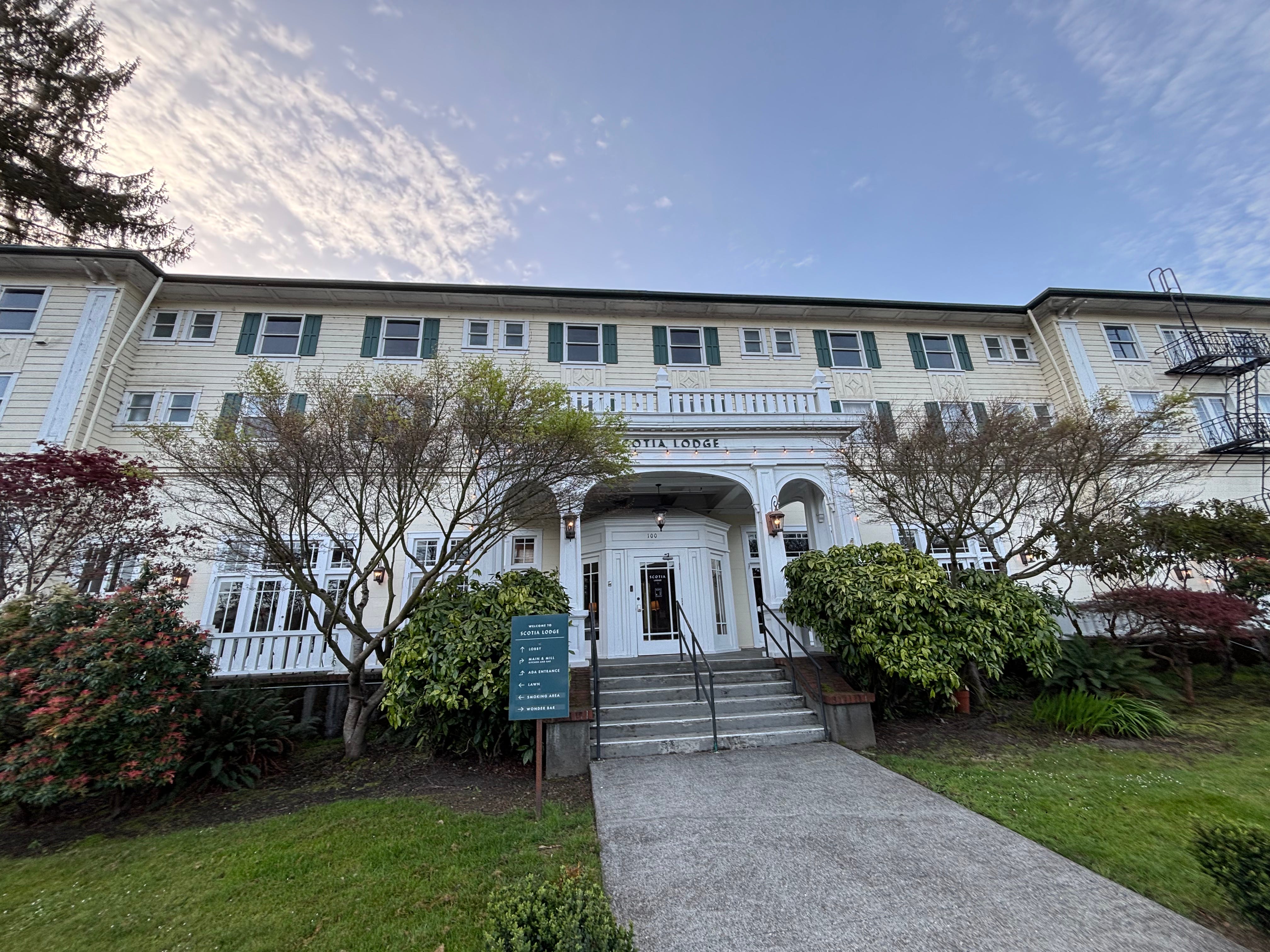
The poem is either a surprisingly optimistic view of the role of computers and machines in a future utopia or, alternatively, a deeply sarcastic note on the impossibility of that vision. It is hard to tell. I was thinking of this poem as I headed north out of the Bay Area, away from the Bladerunner billboards and tech-bro conversations and towards the redwood forests and the Lost Coast. I was driving north for a little over four hours to Humboldt County. As I drove up Highway 101, the presence of vineyards petered out around Geyserville, where I picked up some wine. The road narrowed and the trees closed in on the highway. And what trees. Thick girthed, soaring redwoods. The Mediterranean-looking, vineyard-covered landscape of Sonoma County had given way to something that looked much wetter and bigger. My drive ended at Scotia and the Scotia Lodge, a hotel that reminded me of a cross between The Shining and Twin Peaks (in a good way) sitting across the road from a massive, abandoned lumber processing plant, a supermarket, a gas station, and not much else.
Humboldt County is part of the Emerald Triangle, an area that was remote enough to be the largest cannabis growing area of the United States from the 1960s onwards and certainly well before the legalization of cannabis in 2016. It was precisely the remoteness of Humboldt County that had attracted San Francisco hippies, activists and artists to the area in the early 1970s. Some of them, it turned out, were to become environmental activists, taking it upon themselves to restore watersheds which had been decimated by the logging of redwoods and the rise of cannabis plantations. Of particular concern was the declining numbers of salmon in the Eel and Mattole rivers. I had escaped the AI world of the Bay Area to talk to these people about how they had restored both the watershed and the salmon runs – about how they related to the place they lived in relation to the philosophy of bioregionalism.
***
The next day I drove out to the town of Petrolia, beside the Mattole River. The drive is exhilarating – ascending to rolling range land for cattle, out of the spectacular trees the scene reminded me of parts of Scotland or Wales complete with roads too narrow for two cars to pass, cattle grids, and moments where I had to stop for the cattle. The twisty road makes its way across and around steep hills before plunging to the edge of a dramatic coast where the sea meets the hills – roaring breakers, the mist of sea spray, and chunks of salt-bleached trees. This is just north of the Lost Coast, so-called because of depopulation that happened in the 1930s and the inability or unwillingness to pay for a major highway. The area is effectively bypassed and undeveloped. You could easily miss the town of Petrolia – a town that acquired its name by being the site of the first oil well drilled in California – an ironic site for bioregional place-making. This is a very remote corner of northern California marked by steep hills, redwood stumps, and a river – the Mattole – that closes to the sea every summer and punches its way open in the first big autumn storm. Cattle, trees, and a few hundred people. Not the kind of place where you’d expect a nine‑person cast, a four‑piece band and a touring show.
I drove out past Petrolia to meet with some of the people responsible for restoring the river and the salmon. Among them were David Simpson and Jane Lapiner. I visited their self-made converted barn at the end of a dirt track and was introduced by a rancher neighbour. I was glad my rental car had been upgraded to a Chevy Blazer. The Prius I had intended would not have survived. The house was full of books, posters, black and white photos of dancers all lit by the sun coming through the large picture windows. A large poster of stylized figures knocking down an oil derrick read People vs. Fossil Fuels. A poster with the heading “human nature” of a Robert Crumb drawn wolf read The Wolf at the Door. I sat down with David and Jane, eager to hear about bioregional philosophy, erosion abatement, salmon hatcheries, and culvert replacements. What I got was entirely different.
***
David and Jane are incomers. Both émigrés from the East Coast. Jane had attended Bennington College, the birthplace of both modern dance (Martha Graham) and electronic music. It is a college with no grades where my daughter Alice had decided to go (now, in Bennington tradition, an anarchist organizer and book seller). David had been to the University of Wisconsin at Madison, where I had taken my PhD with the noted humanistic geographer, Yi-Fu Tuan and where I had met my wife, Carol. We had a lot to talk about. David and Jane had made their way to San Francisco and Berkeley where they had been members of the Diggers and the San Francisco Mime Troupe in the late 1960s. The Diggers were a band of anarchist hippies who had the slogan “Everything is free. Do your own thing.” They were named after the English Diggers of the 17th Century who had sought to farm common land in order to tackle poverty.
The idea of the Earth as a “common treasury” was replicated in the 1960s Diggers’ commitment to the idea of supplying things for free – free music, free medicine, free art, free food. They sought to live a life outside of the dictates and expectations of capitalism aided, often, by the likes of the Grateful Dead, Jefferson Airplane, and Janis Joplin who agreed to play at free parties – or “happenings”. In addition to providing things for free, the Diggers consistently used forms of theatre to spread their message. Indeed, the Diggers had arisen, in part, out of the San Francisco Mime Troupe and lived by the code “create the conditions you describe” – acting as though a better future is already here – hence the act of giving out things for free. The activities of the Diggers and associated groups would eventually lead to what would be called “The Summer of Love” in 1967 centered on the Haight Ashbury district where the Diggers were active. By that time the member of the Diggers had grown jaded with the massive numbers of incomers looking to tune in and drop out and decided to leave the city. Before doing that, they held a parade through the Haight proclaiming The Death of the Hippie on October 6th, 1967. The Diggers began to disperse, moving out into rural communes and homesteads in Humboldt County and elsewhere.
One of the Diggers activities was a constant stream of free broadsides and pamphlets – forerunners of the zine culture. The so-called Communications Company used two Gestetner mimeograph machines that had been obtained for free in true Digger style to print and distribute daily broadsides in Haight Ashbury throughout 1967. One of their publications was an 8.5-by-11-inch mimeographed broadside of Richard Brautigan’s All Watched Over by Machines of Loving Grace accompanied by a large image of a megaphone. The poem was to be reprinted in the final edition of The Digger Papers in August 1968 just as the Diggers dispersed to places like Trinidad and Petrolia in Humboldt County.
David and Jane had been active members of both the San Francisco Mime Troupe and the Diggers before they arrived in Humboldt County. Their house was full of material from the day. They laughed as they told me how collectors now wanted to pay absurdly large amounts of money for the posters that had once been dispersed for free.
***
Back in the late 1980s and early 90s, as salmon runs were collapsing and logging roads caused runoff into the rivers, a group of local residents, including David and Jane, decided they had to make sense of what was happening in a way their neighbours could feel in their bodies. They didn’t start with a policy paper or a bioregionalism reading group. They started with musical comedy.
They called it Queen Salmon with the subtitle “a biologically explicit musical comedy for people of several species.” The subtitle gives you a flavour of the thing. The play follows a Chinook salmon from ocean to river mouth to spawning grounds and back into the bellies of bears and humans. Along the way, in addition to salmon, you meet loggers, ranchers, illegal spear‑fishers at the river mouth, the CEO of Pacific Lumber from the city, and a chorus of salmon spirits. The whole community’s argument about what the river is for – livelihood, profit, wildness, dinner – was played out on stage.
What struck me, listening to David and Jane, the couple who wrote and directed it, was how absolutely rooted in the place it was. David noted how “The whole situation was a rural community of non-professional performers creating original material – all from here.” Every character, apart from the salmon, was built from someone who would be in the audience. A logger who slowly comes to understand “the beauty of restoration” because, in real life, he loved working in the woods and was torn between his job and what he could see happening to the hillsides. The local ex‑con who once beat up two highway patrolmen for stopping him on the road. And, of course, the amorous salmon.
The songs were equally specific. At one point in our conversation, Jane was joined by David in rendition of a song called Spawning Time – a duet between two salmon.
When you are a salmon,
you only get one shot.
Most all the other creatures
get to do it quite a lot.
So when the wind is blowing cold,
my blood is running hot,
I better get my ass upstream
before it starts to rot.
My sense of smell will guide me.
My love cannot fail.
Upstream lies my only piece of tail.
The refrain goes:
“Spawning time, we’re gonna do it till we die,
Take me, take me…
Spawning time, we’re gonna do it till we die,
Make me, make me…”
The rendition made us all laugh just as the audience must have laughed a quarter of a century earlier. They explained how the song was sung by a cast all dressed in skin-tight salmon suits – including their daughter, Joyful. I wish I had been there. The song is funny, rude, and accurate. The fish really do have one shot. They swim upriver, their bodies breaking down as they go, and they really do die on the spawning grounds. Reproductive biology is made tangible. Many years after the last tour, and not long before I showed up, Joyful, got a whole hall of Humboldt locals – people who had once speared salmon illegally, people who had sat through endless meetings about hatch boxes and timber harvest plans – to join in that chorus. “Spawning time, we’re gonna do it till we die…” Everyone knew the words. Other songs had titles like “The Different Priorities Waltz” and “A Girl Knows her Watershed”.
***
It seems to me that Queen Salmon does at least four things that are important for anyone interested in the local.
First, it takes complex ecological processes and turns them into story and song without flattening them. The play is “biologically explicit” in the best sense: it gets the details right, but you don’t experience it as a lecture. You experience it as romance, sex, hunger, conflict, timing. You come away with a sense of salmon as beings with their own urgencies, not just as numbers on a fishery biologist’s graph.
Second, it stages a community argument in a way that lets people see themselves. The illegal spear‑fishers at the river mouth are shown with sympathy as well as critique. The rancher who loves the hills and also makes a living from cattle is not a villain. The corporate raider from the city is a caricature, but a recognisable one. It is easy to imagine that people could see their own logic, and its limits, on stage without feeling directly attacked.
Third, it blurs the boundary between theatre and everyday life. It was people in the valley who performed the play and formed the first audience. Nine actors, four musicians and three stage workers were all from Humboldt County. It was people in the valley who the characters were based on. It wasn’t a show that a professional troupe brought in – it was something about the watershed that had been made by the watershed. A bioregional version of Brecht’s Lehrstücke(learning plays), or Augusto Boal’s invisible theatre, where the barrier between actors and audiences is broken down. Local people learning their own place by performing it. Joan Schirle, Director of the Dell’Arte International School of Physical Theatre at Blue Lake would tell a reporter that “It was like they had half the population of Petrolia moving, taking the show on the road. Here you had a group of people connected because they shared the same watershed producing a cultural event. That’s not done a lot.”
And finally, it circulates. Queen Salmon didn’t only play in the Mattole Valley. They took it up and down the West Coast, performed it in Portland, in San Francisco, in fishing towns and logging camps where similar tensions were playing out. The script never stopped being local but audiences in other valleys and cities could recognize themselves in it not because it was generic, but because it was specific enough to give them something to translate. They could apply it to their own version of “here”.
A piece of musical comedy helped make a watershed into a community. It provided a shared repertoire of images, ideas and tunes that people could draw on when haggling over culverts, or hatcheries, or logging permits. You could say to your neighbour “remember what happened when the salmon met the logger,” and they had a good chance of knowing what you meant. The local had acquired a musical, embodied dimension. Years later when Joyful came back to gently roast her parents, a whole audience could sing along.
David and Jane’s account of Queen Salmon suggested to me that theatre can be one of the ways a place becomes conscious of itself. It can be a forum where rivers and roads, animals and jobs, old ranchers and new arrivals are all present at once as characters you can sing with and against. When David and Jane started talking about theatre, I saw it as a distraction from both the serious conversation about bioregional philosophy I was hoping for and the nitty-gritty details of how to manage a watershed that I was expecting. Now I see how it was central.